
Diminishing Returns of Healthy Habits

Diminishing Returns are defined by Webster as “benefits that, beyond a certain point, fail to increase in proportion to extended efforts.”
Diminishing returns, sometimes called the Law of Diminishing Returns, often refer to businesses. For example, as a company increases the number of employees (labor), its productivity increases. After a while, the increase in benefits slows down—adding new employees doesn’t help as much as it used to. Eventually, the company will lose money if it continues to increase labor costs above a certain amount. I apply this law to health.
Look at this chart:
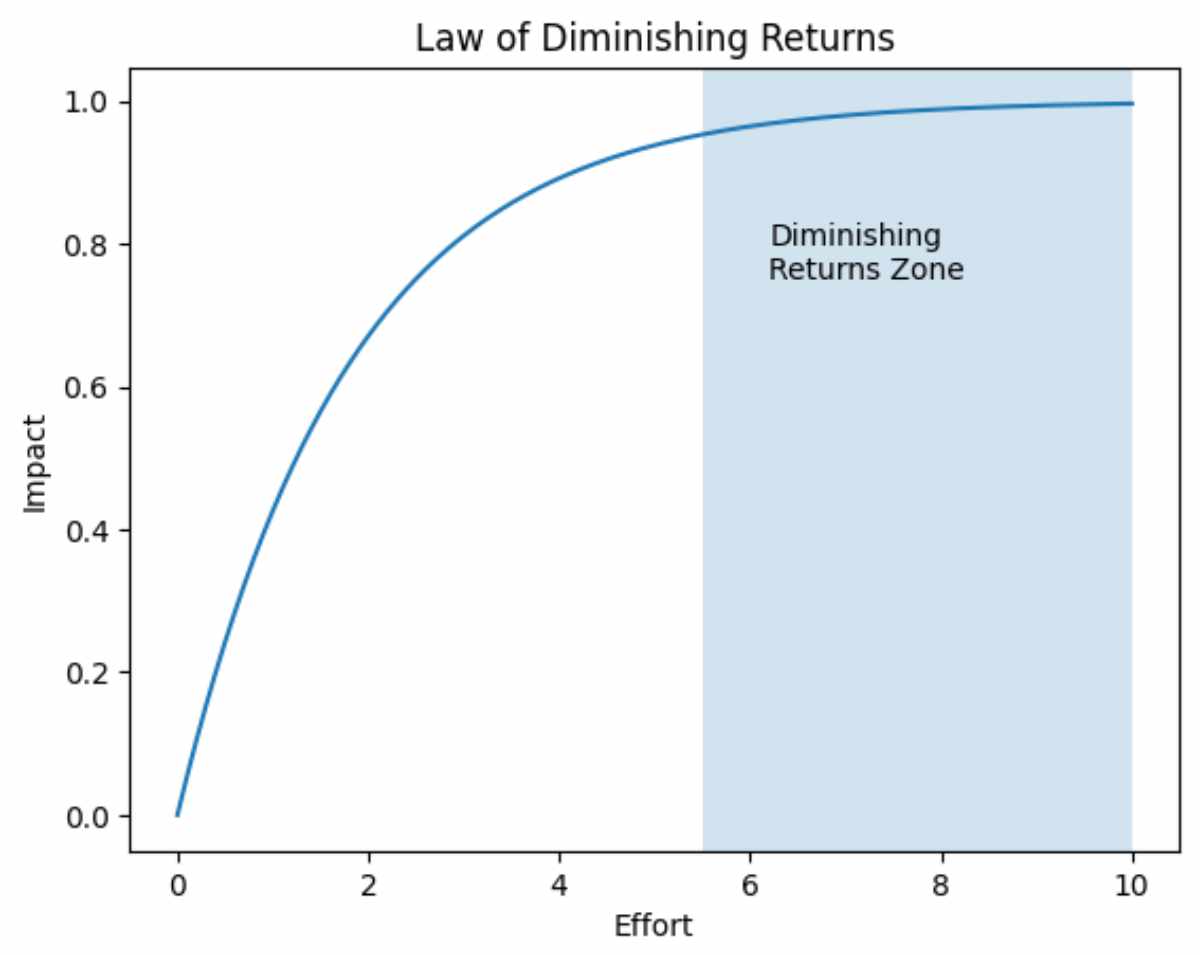
Along the bottom is the effort you put into a healthy habit. Let’s say aerobic exercise. On the left, going vertically, is the impact that exercise has on your health: on weight loss, heart attack risk, and a multitude of other issues. If you are at zero effort, meaning you don’t exercise at all, there is no impact, of course. As you put in more effort exercising and move along the curve to the right, the impact increases and your health gets better. When your effort reaches five or so on my chart, but every healthy habit is different for every individual, the increase in benefit diminishes. To clarify further, for each increase in exercise, you get less of an improvement in your health. It still improves, just not as much.
Here is a real-world example. As I said in a prior post, a key to good health is to concentrate on the big things first. Exercise is a big thing. Say you never exercise at all, and you start walking a mile, three days a week. As you increase to 7 days a week, your cardiovascular health improves significantly. You are on the left part of the curve, which we call the steep part of the curve. If you get in better shape and switch to running a few days a week, your health improves further, at a good rate. If after a year of working out, you’re running six days a week for three miles, you are probably at five or six on the graph, and the curve starts to flatten. If you increase how much you run, the benefits you see will not increase as much or as fast as when you started. That is the law of diminishing returns. Eventually, even with more effort, the benefits may not increase at all. This is called a plateau. Running six miles a day, six days a week is not much better than five miles a day. See my book for more details on the benefits of exercise.
The same law applies to the weight loss that follows as you improve your diet by cutting calories, cutting carbs, or, in my recommendation, getting rid of the bad carbs that hinder weight loss. When you cut back on enough calories or bad carbs, you lose weight. As you cut back more and more, you lose weight faster. Eventually, you may reach a level of cutting where the rate of weight loss slows down. You may still be losing weight, but not as fast. This happens more with cutting calories than bad carbs, but it can happen with any diet, even the new GLP-1 medications and bariatric surgery. If you use the diet I recommend, The Three Rules to Lose Weight and Keep It Off Forever, it usually doesn’t reach the plateau where weight loss stops until you reach your goal.
Sometimes, if you keep increasing whatever you are doing, you may start to make something worse. You know this intuitively because it’s true for many things. Sometimes, after the plateau, negatives occur. Adding salt to food is an obvious example. If there isn’t enough salt, adding salt makes it taste better. But too much salt will ruin the dish. This is the best portrayal I have seen.
This happens with many healthy habits. Cutting calories too much leads to malnutrition, and running too much can be dangerous. Most vitamins and supplements have diminishing returns at a fairly low level, and a plateau is quickly reached. After the plateau, if you keep increasing, even some vitamins can become toxic, including vitamins D and A. As you know, this often happens with medications, and the toxic dose varies for different medications. I am on a relatively low dose of a blood pressure medication. If I doubled the dose, I would probably have side effects. With medications and supplements, the problem is easily avoided by reading labels and checking with your doctor.
An important problem with diminishing returns is that you think you’re helping things by increasing efforts with one healthy habit, ignoring others where you could improve and make a difference. Many weightlifters keep increasing their efforts and ignore diet and cardiovascular exercise. Others take every supplement ever invented and don’t eat healthy or exercise. You can spend a lot of money eliminating more and more plastics from your diet and forget about losing weight. Some will read every label to eat only organic and non-GMOA and not work on their weight. You have to be aware of where your efforts fall on the curve above, and that may require consulting a medical source.
Ignoring the law of diminishing returns sometimes distracts us from things we could do for our happiness and well-being. Taking reasonable protection against infections is wise, but isolating yourself from others leads to loneliness and depression. Instead of exercising so much, I could spend more time with my family. I could also practice meditation or develop other habits that would help my mental health. Despite what some people say, butter and red meat have health risks. Working hard and cutting red meat and butter to twice a month can be helpful, especially if you’re at increased risk of heart disease. Cutting further to zero has no proven benefit. I like eating red meat and foods with butter in them, and will not eliminate them from my diet for no benefit.
I strongly recommend working on healthy habits and concentrating on the part of the curve that is to the left of the diminishing returns zone. A good guide is my book, The Six Rules for a Longer, Healthier Life. Now, there is one more thing I want to mention.
Keep in mind a very important concept: The Threshold Effect.
The threshold effect is when you attain little or no benefit until you reach a level of effort or change. This is extremely important if you are on a low-glycemic diet, such as The Three Rules to Lose Weight and Keep It Off Forever, or a low-carb diet like the Atkins Diet (similar to Keto), but it’s seen to some degree on a low-calorie diet. As you start to cut back on bad carbs or calories, you may not initially notice substantial weight loss, though some do. As you increase your efforts, the amount you lose on a weekly basis will increase rapidly. If you give up all bad carbs, as I usually recommend, you will definitely have crossed the threshold and will lose a substantial amount of weight every week. Eventually, you may eventually reach a plateau, usually when you’re at the weight level you want to be.
See the graph. You may not notice much, if any, weight loss until you reach the threshold. In my graph, I arbitrarily started the weight loss at about 2.5 units of effort. That might be eliminating 90% of bad carbs or cutting calories by a few hundred a day.
When you reach 2.5, you lose weight faster and faster until you get diminishing returns. You lose weight, but each time you cut calories or bad carbs, the weight loss diminishes. Eventually, you may reach a plateau.
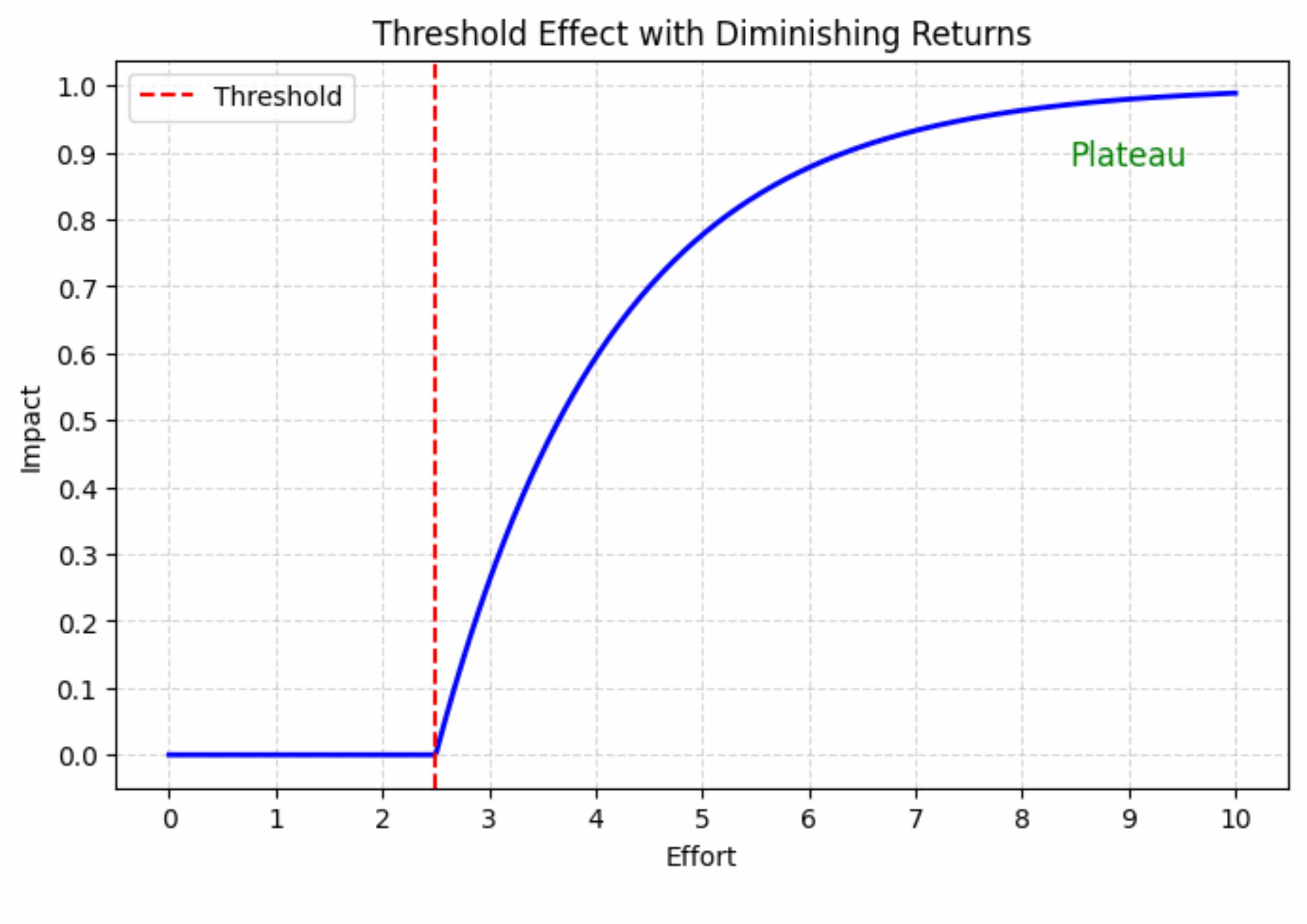
A common mistake is to forget the Threshold Effect if you cut back on your efforts. You may expect to have continued success when you slack off a bit, because you are eating fewer bad carbs than when you started. Perhaps you started eating one or two cookies a day or a few pieces of bread a week. However, if you slack off enough, you will reach the threshold in reverse, and you are likely to stop losing weight and even gain weight. I have made that mistake too many times to count.
The threshold for weight loss can be very high for some people. To lose weight, some need to get below 1200 calories a day. On keto, they need to be below 20 grams of carbs a day, and on a low-glycemic diet, you may need to give up all or nearly all bad carbs. Fortunately, you can otherwise eat what you want and should never be hungry.
Cutting calories has an additional problem—tolerance. Your body becomes accustomed to the lower calorie intake. If you start at 2000 calories, your threshold for weight loss might be 1600 calories a day. But, if you eat that amount, you will see diminishing returns quickly, so that you lose none or virtually none after a month. You’ve reset the threshold. Now, if you go back to 2000 calories, you will gain weight when before you had been stable at that level.
Keep in mind where you are on the curves above. Push hard enough to cross a threshold, and be especially careful not to cross that threshold in reverse if you back off on your efforts. Additionally, if you have reached the level of diminishing returns, don’t continue to increase your efforts at the expense of another healthy habit you could work on.
Disclosure: Some of the links in this post are 'affiliate links.' This means if you click on the link and purchase the item, I will receive an affiliate commission.
Disclosure: Some of the links in this post are 'affiliate links.' This means if you click on the link and purchase the item, I will receive an affiliate commission.